
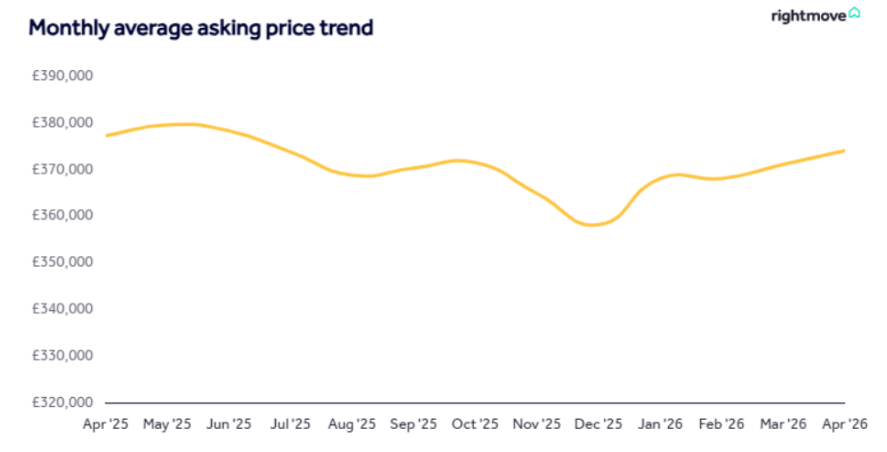
 While higher mortgage rates and increased competition among sellers have slowed typical spring growth, the housing market has shown resilience in the face of global uncertainty, Rightmove reports.
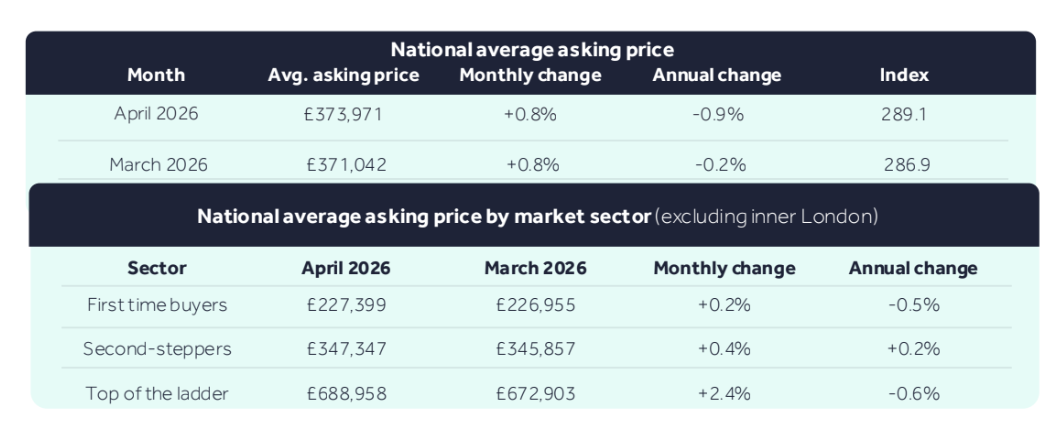
Data from the platform shows that the average price of a newly listed home rose by 0.8% (+£2,929) this month to £373,971 – which is below the long-term April average increase of 1.2%. The more subdued growth comes as borrowing costs remain high and the number of homes for sale is at its highest level for this time of year in 11 years.
Despite these pressures, market activity remains relatively good. Buyer demand since April is down 7% compared to the same period last year, but broadly in line with trends seen earlier in 2026. The number of agreed sales is just 3% behind last year, while new listings are down just 1% and 13% higher than in 2024.
Price growth has been strongest at the top end of the market, particularly in larger homes where buyers are less dependent on mortgages. Scotland also performed better, with asking prices rising by 4.3%.
Colleen Babcock, property expert at Rightmove, said: “With mortgage rates remaining high due to the war in Iran, it is no surprise that price growth is proving strongest in parts of the market not exposed to higher borrowing costs, such as terraced houses, while areas more exposed to interest rates are seeing slower growth.
“Across Great Britain, Scotland stands as an example of resilience, with average prices rising by more than 4%. Low average asking prices and a faster home-buying process continue to support price growth in the Scottish market.
“However, for most of the market, the combination of rising mortgage rates and the number of homes for sale being at their highest level for more than a decade means that competitive pricing is critical for sellers who want to attract buyer interest and ensure sales this spring.”
Higher borrowing costs have resulted from global instability, with Rightmove’s mortgage tracker showing that the average two-year fixed rate has risen to 5.42%, from 4.25% before the start of the Middle East conflict. This adds around £235 to the typical monthly mortgage payment.
However, several factors are helping to support activity. Average yields are up 3.9% year-on-year, well above asking prices, which are down 0.9% year-on-year, while recent changes to debt-to-income lending rules mean buyers can generally borrow more. Demand among first-time buyers also remains relatively strong, down only 6% compared to last year.
Matt Smith, mortgage expert at Rightmove, said: “At the start of the year there was growing optimism that the base rate would continue to fall, but this picture has changed following the conflict in Iran. Financial markets are now looking at a massive increase in the Bank of England’s base rate this year rather than a cut, which would translate into higher mortgage rates beyond 2026 and higher than this time last year.
“The initial shock appears to have passed, with mortgage rates stabilizing over the past few weeks, but they remain high. The next step will depend on upcoming UK inflation data and how the Bank of England responds. If policy decisions are in line with current market expectations, there is more likely to be a period of relative stability than a meaningful decline.”
Smith said: “Even if external pressures ease, including the improving situation in the Middle East, history suggests that mortgage rates are unlikely to decline quickly, meaning high borrowing costs will persist for the foreseeable future.”