
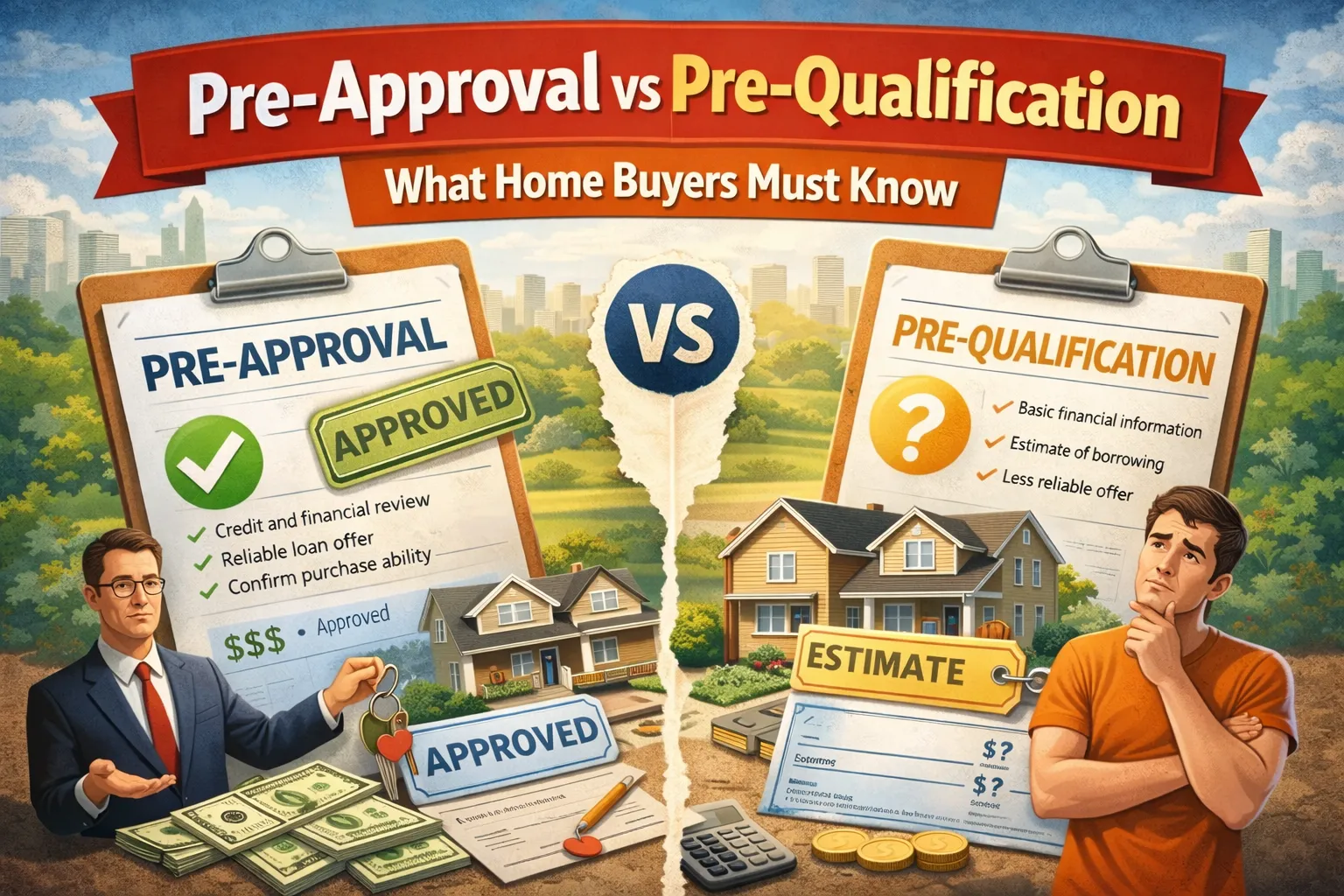
In today’s fast-moving U.S. housing market, walking into an open house without a clear financing picture is like showing up to a gunfight with a butter knife. Sellers and their agents instantly size you up: Are you serious, or just kicking tires? The single fastest way to prove you belong at the table is to understand the real difference between mortgage pre-qualification and pre-approval.
Most buyers—even repeat buyers—still use the terms interchangeably. That mistake can cost you the house you want, thousands in earnest money, or weeks of heartache in multiple-offer situations. This 2026 guide cuts through the jargon and shows you exactly what each step means, why one is dramatically stronger than the other, and how to use them strategically in today’s environment.
What Is Mortgage Pre-Qualification?
Pre-qualification is the quick-and-dirty first conversation with a lender. You hop on the phone or fill out an online form, tell them your income, assets, and debts (usually self-reported), and in 5–15 minutes you walk away with a rough idea of how much you might borrow.
No documents are verified. No credit report is pulled (or at most a soft pull that doesn’t hurt your score). It’s essentially a back-of-the-napkin estimate.
In 2026, with average credit scores for approved mortgages now hovering around 774 (per recent Ellie Mae data) and debt-to-income ratios under intense scrutiny, pre-qualification is useful only as a reality check before you start shopping price ranges.
Think of it as asking a car dealer, “What payment could I probably afford?” Helpful, but nobody is holding a spot on the lot for you.
What Is Mortgage Pre-Approval?
Pre-approval is the heavyweight division.
The lender pulls your credit, reviews W-2s, pay stubs (usually the last 30–60 days), two years of tax returns, bank statements, and sometimes asset statements or gift letters. They underwrite you as if you already had a signed purchase contract.
When they’re done—typically 3–10 business days later—you receive a formal pre-approval letter stating the exact loan amount, interest rate range, and program you qualify for. That letter is gold in a seller’s eyes.
In multiple-offer reviews, listing agents now routinely ask: “Is this a full underwrite pre-approval or just a pre-qual?” Many sellers won’t even look at offers without the former.
Side-by-Side Comparison: Pre-Approval vs Pre-Qualification (2026 Reality Check)
Here’s the no-nonsense breakdown:
| Feature | Pre-Qualification | Pre-Approval |
|---|---|---|
| Credit check | None or soft pull | Hard inquiry (drops score 3–10 pts temporarily) |
| Income/asset verification | Self-reported | Full documentation required |
| Time to complete | Minutes to same day | 3–10 business days |
| Letter strength with sellers | Weak | Very strong |
| Binding on lender? | Not at all | Conditional commitment (subject to property & appraisal) |
| Cost to buyer | Free | Usually free, but hard inquiry affects score |
| Good for | Budget shopping & motivation | Making offers & winning bids |
Why Pre-Approval Has Become Non-Negotiable in 2026
Inventory remains painfully low in most desirable metros—Boston, Seattle, Denver, Raleigh, Austin, and virtually every decent suburb within 90 minutes of a major job center. The National Association of Realtors reported just 3.1 months of supply nationally in January 2026, well below the 5–6 months considered balanced.
When 15–30 offers land on a well-priced listing in the first weekend, sellers eliminate anyone who isn’t demonstrably ready to close. A pre-approval letter signals:
- You’ve already survived the lender’s microscope.
- The only remaining hurdles are appraisal and title.
- You’re far less likely to fall out in financing contingency.
Redfin’s 2025 year-end data showed that offers accompanied by a full pre-approval beat otherwise identical offers by an average of 1.8% in final sale price and were 63% more likely to win in multiple offers.
Real-Life Scenarios from the Trenches
Scenario 1 – The First-Time Buyer in Wellesley, MA (Spring 2026)
A young family finds their dream 1960s colonial listed at $1.38M. They have a pre-qual letter from an online lender. Another buyer submits $1.445M with a local lender pre-approval underwritten to the exact loan amount. Seller chooses the pre-approved buyer even though the offer was $65,000 lower. True story—happened to one of our buyer clients last month.
Scenario 2 – Cash Buyer Myth
Many buyers think a large down payment lets them skip pre-approval. Wrong. Sellers still want proof the bank will actually fund the balance. We’ve seen “cash” buyers lose because they only had a pre-qual letter and the seller worried the funds weren’t seasoned or were coming from a business account requiring extra documentation.
Scenario 3 – Rate Shopping Mistake
A physician client got pre-approved with Lender A at 6.625%. Two weeks later rates dropped. He got a new pre-approval from Lender B at 6.25% and we resubmitted. Seller had already accepted another offer because our original letter was now “stale” (most are only good for 60–90 days). Lesson: Time your pre-approval to the offer window.
Costs Involved – Yes, There Are Some
Pre-approval itself is almost always free. However:
- Hard credit inquiry = temporary 3–10 point score drop (recovers in a few months; impact minimal if you’re not applying for other credit).
- Appraisal fee (only if you want a pre-approval that includes a specific property) = $500–$800.
- Rate lock fee (rarely required upfront in pre-approval stage) = sometimes $500–$1,000 if you lock early.
Bottom line: The real cost is the time and paperwork—but it’s the cheapest insurance you’ll ever buy in this market.
Expert Tips from Agents Who Close 50+ Transactions a Year
- Get pre-approved before you even contact an agent. Serious agents are drowning in lookers; they prioritize pre-approved buyers.
- Use a local or regional lender when possible. Sellers and listing agents trust them more than the big online shops.
- Refresh your pre-approval every 60 days if you’re shopping longer than that. Rates change, income changes, credit changes.
- If your score is borderline (below 720), pay down revolving debt aggressively before applying. Every 20-point gain can save you $50,000+ in interest over the life of a $800k loan.
- Ask for a “fully underwritten pre-approval” – some lenders will actually underwrite everything except the property. These are nuclear in multiple offers.
- Never, ever lie on a pre-qual form “to see higher numbers.” When you later apply for real pre-approval, the discrepancy kills credibility.
Frequently Asked Questions (2026 Edition)
Q: Can I get pre-approved with a 620 score in 2026?
A: Yes, but only for FHA (3.5% down) and possibly VA/USDA. Conventional loans now effectively require 680+ for the best rates and LTVs.
Q: How long does pre-approval last?
A: Most letters are valid 60–90 days. Credit reports expire after 120 days at the bureaus.
Q: Will getting pre-approved hurt my credit score significantly?
A: One hard inquiry drops the average score 5 points or less and falls off the report in 24 months (stops affecting scores after 12).
Q: Do all-cash buyers need pre-approval?
A: No, but proof-of-funds verification from the bank (not just a screenshot) has become the equivalent requirement.
Q: Can I switch lenders after pre-approval?
A: Yes, but you’ll need a new pre-approval letter. Switching too late can delay closing and trigger financing contingency issues.
Q: Is an automated underwriting pre-approval as strong as a manual one?
A: In 2026, yes—Desktop Underwriter and Loan Product Advisor findings are accepted everywhere. Manual underwrites are now rare except on jumbo or complex files.
The Bottom Line for 2026 Home Buyers
Pre-qualification is a conversation. Pre-approval is a contract—almost.
In a market where listings last days, not weeks, and sellers hold all the cards, the buyers who win are the ones who show up fully dressed for battle. Get your full pre-approval before you fall in love with a house, and you’ll dramatically increase your odds of closing on the home you actually want—at terms you can live with.
Work with experienced lenders and agents who understand today’s underwriting nuances. One small misstep on documentation or timing can cost you the house.
Written by Wellesley Realtor Editorial Team
U.S. Real Estate Research & Market Insights