
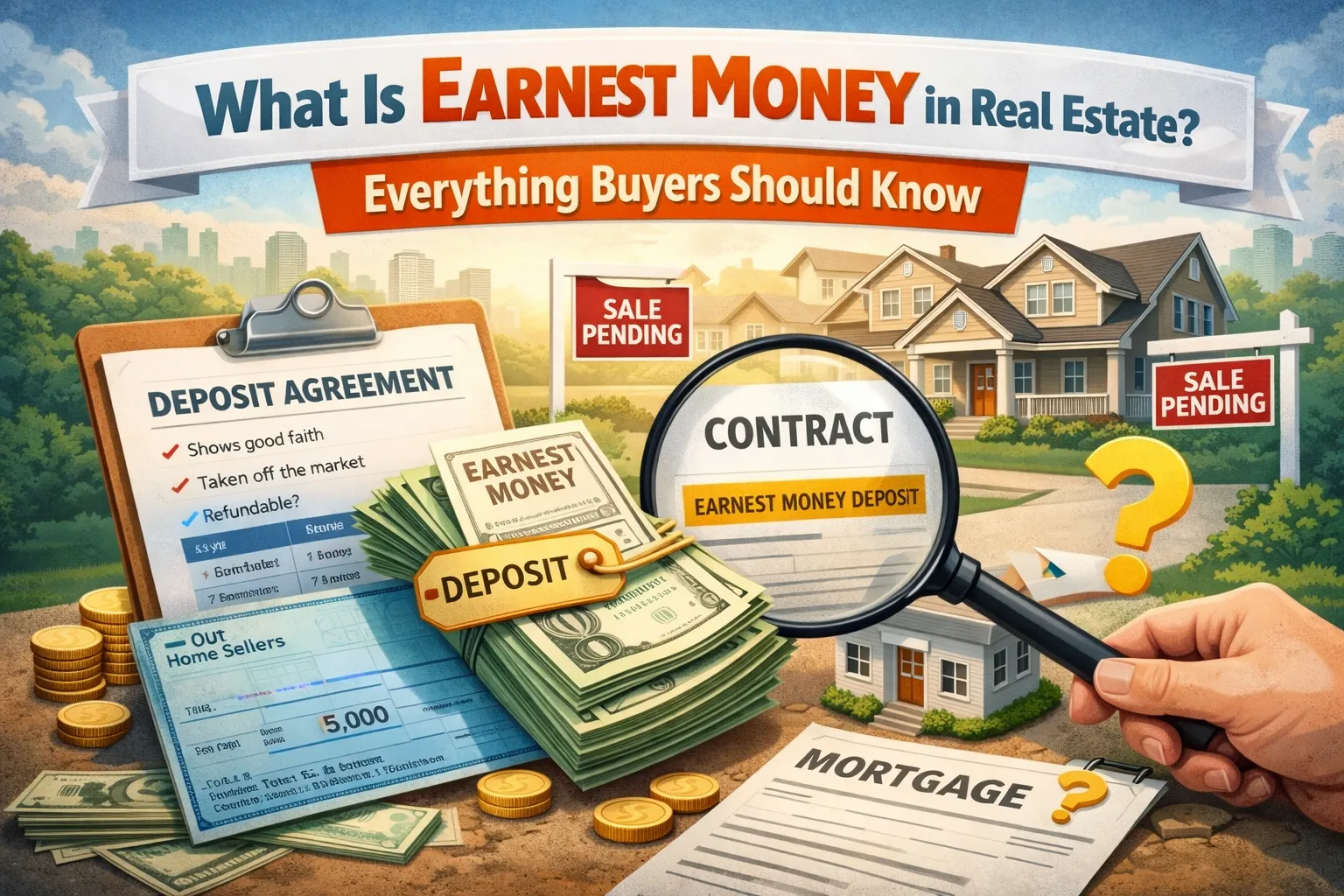
Buying a home is exciting, but the jargon can feel overwhelming. One term that trips up almost every first-time buyer (and plenty of repeat buyers) is “earnest money.” If you’re wondering what earnest money in real estate actually is, how much you need, whether you’ll get it back, and why sellers care so much about it, you’re in the right place.
This guide breaks it all down in plain English, with real numbers from today’s U.S. market and practical advice from someone who has closed hundreds of transactions in Massachusetts and beyond.
What Exactly Is Earnest Money?
Earnest money—sometimes called a good-faith deposit—is money you put down when you make an offer on a house to prove you’re serious about buying it.
Think of it as a deposit that says, “I’m not just kicking tires; I really want this house.” The money is held in an escrow account by a neutral third party (usually a title company or real estate brokerage) until closing. At closing, your earnest money is credited toward your down payment or closing costs.
It is not an extra fee. It’s part of the money you’re already bringing to the table.
How Earnest Money Works Step by Step
- You find a house and decide to make an offer.
- Your agent writes the offer and includes an earnest money amount (more on typical amounts below).
- If the seller accepts your offer, you deposit the earnest money within a few days—usually 1–5 days, depending on the contract and local custom.
- The escrow agent holds the money. You can’t touch it, and neither can the seller.
- You complete inspections, appraisal, and secure financing.
- If everything goes smoothly, the earnest money applies toward your down payment at closing.
- If the deal falls apart for a reason covered by a contingency (inspection, financing, appraisal, etc.), you get it back.
- If you simply change your mind with no contractual protection, the seller usually keeps it.
That’s the entire lifecycle.
How Much Earnest Money Is Normal in 2027–2027?
Nationally, earnest money typically runs 1%–3% of the purchase price. In expensive or competitive markets, it’s often higher.
Here are real-world benchmarks I’m seeing right now (October 2027):
- National average: 1–2% (Redfin and NAR data)
- California Bay Area, Boston suburbs, Seattle: routinely 3% or more
- Wellesley, Newton, Weston, Wayland (Greater Boston): 2–5% is common, with many listings expecting $50,000–$100,000+ on $2M–$4M homes
- Midwest and Southern markets: often 1% or even $5,000 flat in some price bands
Example: On a $750,000 house in a balanced market, $15,000 (2%) is typical.
On a $2.4 million house in Wellesley, buyers frequently write $75,000–$100,000 to stand out.
In multiple-offer situations, the buyer who offers the highest earnest money (and shows proof of funds) often wins, even if their purchase price is slightly lower.
Factors That Influence Earnest Money Amounts
- Market temperature: In seller’s markets, higher deposits signal strength.
- Price point: Higher-priced homes usually carry higher dollar amounts (both in percentage and absolute terms).
- Local custom: Some areas (e.g., Texas) often use 1% or less; others (e.g., metro Boston) expect more.
- Listing agent’s recommendation: Savvy listing agents will tell the seller, “We have two identical offers—Buyer A is putting down $25k, Buyer B is putting down $100k. Who do you want to work with?”
- Whether the offer is cash or financed: Cash offers sometimes put down less because there’s no financing contingency risk.
Is Earnest Money Refundable?
Yes—usually—if you stay within the contract contingencies.
Most common contingencies that protect your deposit:
- Home inspection contingency
- Financing contingency
- Appraisal contingency
- Sale-of-current-home contingency (if applicable)
- Title contingency
If any of these are not satisfied and you cancel in writing within the allowed period, you get your money back, minus any small escrow fees (rarely more than $100–$200).
You lose the earnest money if:
- You waive all contingencies and then back out anyway
- You miss a deadline (e.g., don’t schedule inspection in time)
- You can’t close because you spent the down-payment money on a boat after getting under contract (yes, this happens)
What Happens to Earnest Money at Closing?
It simply becomes part of your down payment.
Example:
Purchase price: $850,000
Your down payment goal: 20% ($170,000)
Earnest money deposited: $25,000
Cash you bring to closing: $145,000 + $25,000 earnest money = $170,000 total down payment
You never write an extra check for the earnest money at closing—it’s already in escrow.
Earnest Money vs. Down Payment vs. Option Fee (Common Confusion)
- Earnest money: Shows good faith, held in escrow, credited at closing.
- Down payment: The full percentage (5%, 20%, etc.) you put down at closing.
- Option fee (used mainly in Texas): A separate non-refundable fee ($100–$500) that buys you an unrestricted right to terminate during the option period. Most states, including Massachusetts, do not use option fees.
Pros and Cons of Putting Down Large Earnest Money
Pros
- Makes your offer dramatically stronger in multiple-offer situations
- Sellers perceive you as low-risk
- Sometimes sellers will accept a slightly lower price for a higher deposit
Cons
- Ties up more cash for 30–60 days
- Higher financial pain if you make a mistake and lose it
- Opportunity cost of that money sitting in escrow instead of earning interest
Expert Tips from a Veteran Agent
- Never waive the inspection contingency just to “sweeten” the offer. A big earnest money deposit without protection is throwing money into the wind.
- Use an escrow company both sides trust. In Massachusetts, I recommend a reputable real estate attorney or major title company.
- Get proof the money is in escrow. Your agent should send you the receipt within 24 hours of deposit.
- In hot markets, consider an escalation clause paired with a high earnest money amount—many buyers win by $5,000–$10,000 over asking because they showed $100k earnest instead of $25k.
- If you’re worried about tying up cash, some lenders now allow “earnest money loans” or you can use a cashier’s check from a HELOC—talk to your loan officer before you need it.
- Always deposit the money on time. Missing the deadline by even one day can let the seller declare you in breach.
Frequently Asked Questions
Q: Can I use gift funds for earnest money?
A: Yes, most lenders allow it as long as you have a proper gift letter.
Q: What if the seller backs out—do I get my money back?
A: Yes, plus you may be entitled to additional damages depending on state law.
Q: Is earnest money ever non-refundable?
A: Only if you explicitly agree to make it non-refundable (rare and generally a terrible idea for buyers).
Q: How quickly do I get my earnest money back if the deal dies?
A: Usually 3–10 business days after both parties sign a release form.
Q: Can the seller keep my earnest money if the house appraises low?
A: No—if you have an appraisal contingency and cancel properly, it’s returned.
Q: Do new-construction purchases require earnest money?
A: Yes, often much higher—5–10% is common with builders.
Q: Should I increase earnest money after going under contract?
A: Sometimes. Releasing part or all of the inspection contingency and making the deposit non-refundable is a common strategy to keep a nervous seller calm in a shaky market.
Final Thoughts
Earnest money is one of the most powerful tools buyers have to stand out in competitive markets, but it’s also one of the easiest ways to lose five or six figures if you don’t understand the rules.
Treat it with respect, protect it with contingencies early on, and use it strategically when the house is truly the one you want.
If you’re buying in the Greater Boston area or anywhere in Massachusetts and want to talk through how much earnest money makes sense for your specific situation, reach out. I’m happy to run the numbers with you—no pressure, just straight talk.
Written by Wellesley Realtor Editorial Team
U.S. Real Estate Research & Market Insights